Last updated
TI × HI · Free · No signup
Pallet Calculator
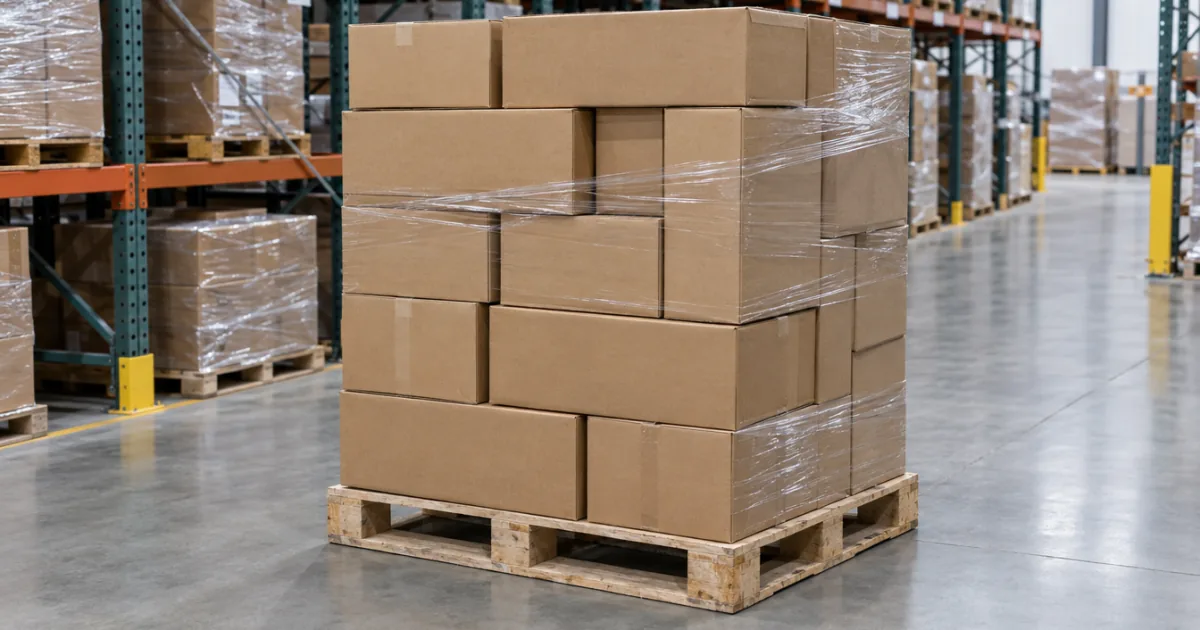
Use this pallet calculator to find how many cases fit on a pallet: cases per layer (TI), layers under your height limit (HI), and the total once any weight limit is applied. It tests mixed layers as well as plain grids, so 16 × 12 inch cases fit 10 per layer on a 48 × 40 pallet, not 9, and it gives the finished height and gross weight.
- Mixed layers that fit more cases
- Height and weight limits
- Hands off to the freight class calculator
Pallet calculator
Cases per layer, layers per pallet and the finished pallet's height and weight. Updates as you type.
A plain grid undercounts: 9 cases where 10 fit
Take a 16 × 12 × 10 inch case and a 48 × 40 pallet. Set the cases out in rows the obvious way, the 16-inch side along the 48, and you get three by three: 9 a layer, with a 4-inch strip of bare deck down one edge. Turn them all the other way and it's worse, four by two, 8.
Now mix them. Two rows of three, 16-inch sides along the 48, use 24 inches of the 40-inch width. That leaves a strip 48 inches long and 16 deep, and four cases turned 90° fill it exactly. Six plus four makes 10, and the layer covers every square inch of the deck.
| Layer pattern | Cases per layer | Five layers |
|---|---|---|
| Grid, 16 in side along the 48 | 9 | 45 |
| Grid, 12 in side along the 48 | 8 | 40 |
| Mixed: two rows of three, plus a turned row of four | 10 | 50 |
Five extra cases a pallet looks minor until you count pallets: nine built with the mixed layer carry the 450 cases that would take ten built as a grid. The calculator looks for layouts like this on every case you enter, splitting the deck into a block one way round and a block turned, along the length and across it, and keeping whichever holds most. When a grid is already best, as with a 12 × 10 × 8 inch case at four by four, you get the grid.
The top-view diagram under the result draws the winning layer to scale, with the two blocks of a mixed layer in two colors so whoever builds the pallet can see which row turns.
How many boxes fit on a pallet: the working
Three numbers decide it: cases per layer, layers under the height limit, and the cases a weight limit allows. The count is layers × cases per layer, or the weight cap if that is smaller. Here is the pallet from above, with a 6-inch deck, a 40 lb pallet, 30 lb cases and a 60-inch limit:
| Step | Working | Result |
|---|---|---|
| Cases per layer (TI) | Best layer of 16 × 12 in cases on 48 × 40 in | 10 |
| Room above the deck | 60 − 6 | 54 in |
| Layers (HI) | 54 ÷ 10 = 5.4, rounded down | 5 |
| Cases per pallet | 10 × 5 | 50 |
| Load height | 6 + 5 × 10 | 56 in |
| Gross weight | 50 × 30 + 40 | 1,540 lb |
Two details trip people up. The height limit includes the pallet, so the deck comes off before you divide, and layers only round down: a sixth layer would finish at 66 inches. The rest is fixed arithmetic. Step one is where a pallet load calculator earns its keep, because that is the step a plain grid can get wrong.
When weight stops the stack first
Give the same pallet a 1,000 lb maximum gross weight and the count falls to 32. The pallet takes 40 lb of the allowance, 960 lb is left, and 960 ÷ 30 is 32 cases. That is three full layers of 10 plus a fourth holding just 2, so the load height drops to 46 inches, and the line under the result says the weight limit stopped it. Leave the maximum gross weight blank and only height counts.
TI and HI: the pallet configuration in two numbers
A pallet configuration is normally written TI × HI. The Australian Food & Grocery Council's TI/HI guide defines TI as "the number of units stacked on one layer of the pallet" and HI as the number of layers. The worked pallet is a 10 × 5. A 12 × 10 × 8 inch case under the same limit is 16 × 6: 96 cases.
The same guide is firm on one point: "TI must not vary between layers of a pallet or between pallets of the same product." So the calculator gives one TI and repeats it; a mixed layer is still one TI, built the same way on every layer. That fixed pair of numbers is what goes on a product spec, which makes this as much a pallet configuration calculator as a case counter.
Height, weight and overhang: whose limits these are
None of these limits is universal. There is no standard maximum pallet height and no single weight for a 48 × 40 pallet; both depend on the pallet's build and on whoever stores, carries or receives it, and when several set a height, the lowest wins. Enter the figure you've been given. The 60 inches and 40 lb on this page are example inputs, not standards.
For the pallet weight, put an empty pallet from your own stock on a scale. Like any pallet stacking calculator, this one is only as good as the limits you feed it.
Overhang
Overhang allowed per side lets each layer reach that far past the deck on all four sides, so 1.5 inches turns 48 × 40 into a 51 × 43 footprint. Sometimes that buys a case. Nine 17 × 13 inch cases cover 1,989 square inches, more than the 1,920 a 48 × 40 deck has, so the most is 8; with 1.5 inches each side, three by three fits. Leave it at 0 unless whoever handles the pallet accepts overhang. The freight class hand-off measures the overhung footprint, since that is the space the pallet takes on a trailer.
Cases on their side
Tick "The case can lie on its side" and the calculator also tries each case with its length or its width as the height. Take a 12 × 12 × 20 inch case, a 6-inch deck and a 36-inch limit. Upright, two layers would need 40 inches above the deck and there are 30, so one layer of 12 is all that fits. On its side the case stands 12 inches tall: two layers of 8, 16 cases. Leave the box unticked for anything marked "this side up".
Standard pallet size and the presets
The US default footprint is 48 × 40 inches, the size often called the GMA pallet. A study of US pallet production hosted by the USDA Forest Service found it "the most common single product", 26.9 percent of 2006 production. GS1's platform type code list describes the 1219 × 1016 mm pallet as "primarily used in the Americas region."
In the calculator, the Pallet size menu holds the pallet dimensions you're most likely to need: 48 × 40 in (North American standard), 48 × 48, 42 × 42 and 48 × 42 inches, plus 120 × 80 cm (EUR) and 120 × 100 cm. For export work, GS1 lists these ISO 6780 sizes:
- 800 × 1200 mm (ISO 1, the EUR pallet)
- 1200 × 1000 mm (ISO 2)
- 1100 × 1100 mm
- 1067 × 1067 mm, which is 42 × 42 in (ISO 4)
- 1219 × 1016 mm, the 48 × 40 in pallet
- 1165 × 1165 mm, used in Australia
Choose the units before the preset. A preset fills the deck in whichever unit is showing, so 120 × 80 cm (EUR) picked while inches are showing comes out as 47.24 × 31.5. Custom takes any size.
After the pallet: freight class, the BOL and the trailer
A carrier sees the finished pallet, not the case. As soon as the case has a weight, a "Check this pallet's freight class →" link appears under the result and opens the freight class calculator with the built pallet already entered: footprint, load height and gross weight. The worked pallet arrives as 48 × 40 × 56 inches at 1,540 lb. That is 62.22 cubic feet and 24.75 pounds per cubic foot, class 65 on the density scale. Used as a pallet builder calculator, one set of inputs gives the warehouse a pattern and the shipping desk a class.
On the bill of lading, each pallet is a handling unit and the cases on it are pieces, so ten of the worked pallets go down as 10 handling units and 500 pieces. The bill of lading template has a column for each. A full trailer is the next question: a 53 ft dry van takes 26 or 30 pallets of this footprint, depending on how they're loaded, and the page on how many pallets fit in a 53 foot trailer works it out for vans, box trucks and containers. Export cartons quoted by volume rather than as pallets belong in the CBM calculator.
The pallet calculator is free and runs online, in your browser. Copy results is for pasting the plan into a packing spec or an email to the warehouse. A shared link reopens the same plan for whoever you send it to, and since the plan is packed into the link, there is nothing on our side to store. Saved plans stay in this browser on this device. The CSV download is a one-row spreadsheet of TI, HI, cases, height and weight for Excel or Google Sheets, and Print gives you a paper copy.
Pallet calculator questions
How many boxes will fit on a pallet?
It depends on the box, the pallet and the height limit, so there is no single number. Find the most boxes one layer can hold, work out how many layers fit under the height limit once the pallet deck is taken off, and multiply the two. A 16 × 12 × 10 inch box on a 48 × 40 pallet with a 6-inch deck and a 60-inch limit gives 10 per layer and 5 layers: 50 boxes. A weight limit can cut that further.
How heavy is a 40x48 pallet?
There is no single weight for a 48 × 40 pallet. It weighs whatever its build makes it weigh, and builds vary. Put an empty one from your own stock on a scale and enter that as the pallet weight. The calculator adds it to the cases for the gross weight and takes it off any weight limit before counting cases. The 40 lb used on this page is an example input, not a standard.
How many pallets fit in a 20 ft container?
A 20 ft standard container takes 9 standard 48 × 40 pallets on the floor, going by the inside size Hapag-Lloyd publishes, 5,900 × 2,352 mm. Ten, a number you will see repeated, needs more length than that box has. Metric EUR pallets (1200 × 800 mm) reach 11, but only with one column turned and the other straight. For containers, 53 ft vans and box trucks, the pallet loading calculator for trailers and containers gives the count and draws the floor plan.
What do TI and HI mean?
TI is the number of cases in one layer of a pallet, and HI is the number of layers. TI × HI is the full pallet: a 10 × 5 pallet holds 10 cases a layer, five layers high, 50 cases. The Australian Food and Grocery Council's guide adds that TI must not vary between layers or between pallets of the same product, which is why a pallet spec gives one TI.
What is the standard pallet size in the US?
48 × 40 inches, often called the GMA pallet. Research by Bush and Araman, hosted by the USDA Forest Service, found 48 × 40 the most common single size, at 26.9 percent of 2006 production, and GS1 describes the 1219 × 1016 mm pallet as primarily used in the Americas. It is the first preset in the calculator.
How tall can a pallet be stacked?
There is no universal limit. The maximum height comes from whoever stores, carries or receives the pallet, and when a warehouse, a carrier and a customer each set one, the lowest applies. Enter that figure as the maximum load height, pallet included. Height matters again in the trailer: two 55-inch pallets stack inside a 53 ft dry van published at 110 inches high, and two 56-inch ones don't.
Does case orientation change how many fit?
Yes, in two ways. Turning some of the cases within a layer can beat a plain grid: 16 × 12 inch cases fit 9 per layer on a 48 × 40 pallet in straight rows, and 10 when one row is turned. Laying a case on its side changes the layer height: a 12 × 12 × 20 inch case under a 36-inch limit gives 12 upright and 16 on its side. Use the second only for cases without a "this side up" marking.
Can cases hang over the edge of the pallet?
Only if the people handling the pallet accept it, and the calculator assumes they don't until you enter an allowance. With an overhang allowed per side, every layer may reach that far past the deck on all four sides. It sometimes gains a case: 17 × 13 inch cases fit 8 to a layer on a 48 × 40 deck and 9 with 1.5 inches of overhang. The freight class hand-off then uses the larger footprint, since that is the space the pallet takes up.
What is cube utilization?
Cube utilization is the share of the space available for cases that the cases fill: their total volume over the deck area times the room above the deck. The worked pallet on this page holds 50 cases of 1,920 cubic inches, 96,000 in all, under 48 × 40 × 54 inches of room (103,680 cubic inches): 92.6%. The calculator shows it as Cube used, next to Deck covered, the share of the deck one layer fills. Deck covered is 100% here, so the lost cube is the 4 inches left under the limit.