Walkthrough · 15 fields · Updated 12 August 2026
How to Fill Out a Bill of Lading
Work top to bottom: identifiers, then the two addresses, then the carrier, then the freight itself, then value and terms, then signatures. Four entries carry real money — the hazardous materials column, the NMFC number, the freight class and the declared value — and those are the four that get freight claims denied.
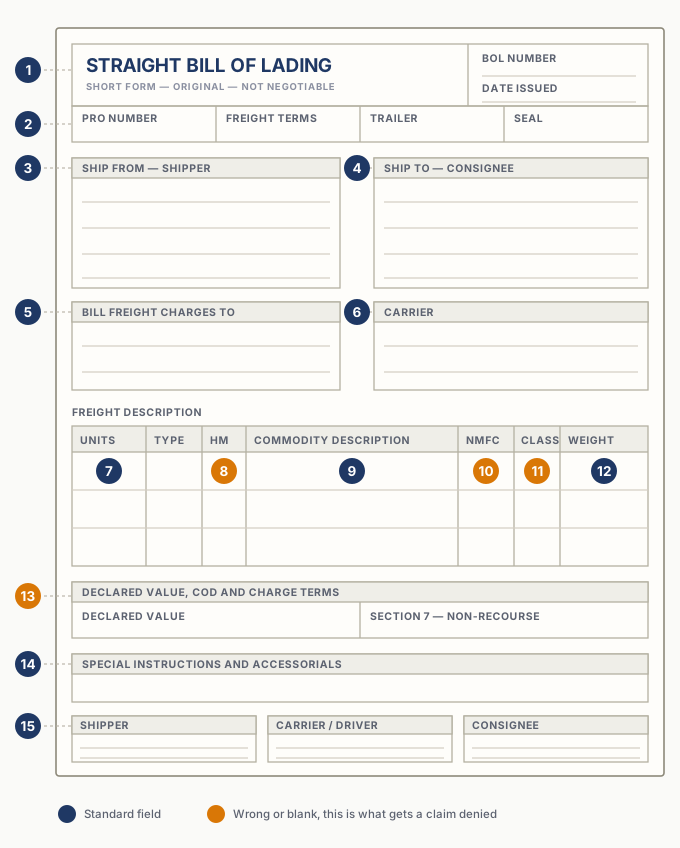
Field by field
1. BOL number and date
The BOL number is yours to choose. Sequential numbering, the purchase order, the sales order — any of them work, as long as you can find the shipment again by it six months later. The date is the pickup date, not the day you typed the form.
If you leave the number blank in the generator, one gets created in the form
BOL-YYYYMMDD-XXXX so no two documents from the same day collide.
2. PRO number and reference strip
The PRO number belongs to the carrier. It usually arrives as a barcode label the driver sticks on at pickup, so print the BOL with this box empty and write it in by hand. Freight terms go here too — prepaid, collect or third party — along with the trailer number, the seal number and who counted the freight.
"Freight counted by" matters more than it looks. If the driver counted, a shortage argument later is between the carrier and its own count. If the shipper loaded and sealed the trailer, mark shipper load and count and the count stays with you.
3. Ship from — the shipper block
Legal company name, street address, city, state and ZIP. Not the trading name, not the brand on the sign outside — the entity that would appear on a claim. Add a contact and a direct phone number; the carrier calls this number when the pickup window slips.
4. Ship to — the consignee block
Same detail, plus two things people skip. Receiving hours, because a driver arriving at 15:30 to a dock that shut at 15:00 costs somebody money. And whether the delivery needs an appointment, because "appointment required" written on the BOL is the difference between a scheduled unload and a redelivery charge.
If the delivery address is residential, a construction site, a school, a military base or anywhere with restricted access, say so here. Those are accessorials, and the carrier will charge for them whether or not you disclosed them.
5. Bill freight charges to
Only needed when the payer is neither shipper nor consignee. Fill it in precisely: a broker, a freight payment company, or a corporate accounts payable address that has nothing to do with the receiving dock. An invoice that lands in the wrong building is an invoice that ages sixty days before anyone notices.
6. Carrier, SCAC, trailer and seal
Carrier name, and the SCAC if you have it — the four-letter Standard Carrier Alpha Code that identifies the carrier on every system that touches the load. Trailer and seal numbers get written at the dock, after the trailer is loaded and closed.
Record the seal number. On a sealed shipment, an intact seal at delivery matching the number on the bill of lading is what rules out the freight having been opened in transit.
7. Handling units and pieces
Two different numbers that get merged into one by people in a hurry. Handling units are what the driver physically moves: six pallets is six handling units. Pieces are what is inside: 144 cartons on those six pallets is 144 pieces.
Carriers rate and count on handling units. Consignees check against pieces. Get both on the document and the two conversations stay separate.
8. The HM column (claim-critical)
If any line is hazardous material, that line has to be identifiable as regulated on the shipping paper — the usual method is an X in the HM column against the entry. The description itself follows a required sequence: identification number, proper shipping name, hazard class or division, then packing group. UN1263, Paint, 3, PG II.
The paper also needs the total quantity, the number and type of packages, the shipper certification, and a 24-hour emergency response telephone number that a person who knows the load will actually answer. A mobile that goes to voicemail does not satisfy the requirement. This is enforcement territory — 49 CFR Part 172 is the authority, and roadside inspections check it.
9. Commodity description
Describe the goods, the packaging and how the load is secured. "Cabinet doors, wood, in cartons on pallets, banded and stretch wrapped" tells a carrier what it is handling and tells a claims adjuster what was protecting it. "Freight" tells nobody anything, and on a damage claim it reads as an admission that you were not paying attention.
Match the description to the NMFC item you are claiming. A description that does not support the class is the first thing an inspection notes.
10. NMFC number (claim-critical)
The item number from the National Motor Freight Classification that covers what you are shipping. It is the reference that connects your description to the class you have declared, and carriers check it.
Do not copy an NMFC number from an old bill of lading and assume it still holds. The classification is maintained and revised, and the industry has moved a great deal of commodity classification onto a density basis. Confirm the current item number with your carrier or your NMFC subscription rather than from memory.
11. Freight class (claim-critical)
One of the eighteen classes from 50 to 500. Four characteristics set it: density, stowability, handling and liability. Dense, stackable, easy-to-handle, hard-to-damage freight sits at the bottom of the scale and costs less to move.
Density is pounds per cubic foot, and it is the one people get wrong because they measure the product rather than the shipping unit. Measure the pallet — length, width and total height including the pallet itself — and use the gross weight. Understate the class and the carrier reweighs, remeasures, reclassifies and rebills, usually with an inspection fee attached.
12. Weight
Actual gross weight in pounds, including pallets, dunnage and packaging. Carriers have scales, and on LTL they use them. A weight and inspection certificate followed by an adjusted invoice is the standard outcome of a hopeful estimate.
Weigh it if you can. If you genuinely cannot, weigh one unit and multiply rather than guessing the total.
13. Declared value (claim-critical)
The most consequential empty box on the form. Where the rate depends on value, the carrier requires the shipper to state the agreed or declared value in writing. Leave it blank and the carrier's tariff limitation of liability applies instead — a released value in dollars per pound, which on light, expensive freight is a small fraction of what the goods cost.
Declaring a value usually costs a little more in freight charges. Compare that against the gap between the per-pound cap and the replacement cost of the pallet, and the math makes itself. Sign Section 7 as well if you want the carrier to collect the freight charges from the consignee and not come back to you.
14. Special instructions and accessorials
Everything the carrier has to do beyond dock to dock. Liftgate at delivery, inside delivery, residential, limited access, notify before delivery, do not double stack, appointment required, keep from freezing.
Write them here even if you already told the sales rep on the phone. The bill of lading is the contract; a verbal instruction is a memory. And if the accessorial appears on the invoice but never appeared on the BOL, you have no argument, because you asked for a service you did not document.
15. The three signature blocks
The shipper signs to certify the description — a regulatory certification when hazmat is aboard. The carrier signs at pickup to acknowledge receipt in apparent good order. The consignee signs at delivery, and that last signature is the one that decides claims.
Tell whoever receives the freight, in writing, to note every shortage, every damaged carton and every broken pallet on the delivery receipt before signing. A clean signature is a statement that the shipment arrived complete and undamaged, and it is very hard to walk back.
Fill it in with the fields already labeled
Every box above, in the same order, with running weight totals and a hazmat flag. Download the PDF when it is done.
Why claims get denied, in order of frequency
Carriers do not deny claims out of malice. They deny them because the paperwork gives them a defense, and under the Carmack Amendment the defenses include an act or default of the shipper. Bad documentation is a default of the shipper.
- The delivery receipt was signed clean. Nothing was noted at delivery, so the record says the freight arrived intact. This is the biggest single cause, and it happens at the consignee's dock, not yours.
- Declared value was blank. The claim is not denied so much as capped, at the tariff's released value per pound. People discover the difference at exactly the wrong moment.
- The description did not match the goods. A vague or wrong commodity description undermines everything downstream — the class, the rate, and the value being claimed.
- Packaging was inadequate. If the freight was not packed to survive normal handling, the carrier points at the shipper's default, and photographs of the packaging decide it.
- The claim was filed too late. Nine months from delivery is the minimum a carrier must allow. Waiting eight of them while somebody chases an email is a common way to lose.
Before the driver leaves
Sixty seconds of checking beats an afternoon of arguing. Run down this list with the document in your hand.
- Consignee name and address match the order, and the appointment requirement is written on.
- Handling units on the BOL match what is physically on the dock.
- Weight is the actual gross weight, pallets included.
- NMFC number and class are on every line, and the description supports them.
- Anything hazardous is marked, fully described, and has a monitored emergency number on the paper.
- Declared value is filled in if the freight is worth more than a few dollars a pound.
- Accessorials are written under special instructions.
- Seal number recorded, if the trailer is sealed.
- Driver has signed, and you have your copy — not a promise of one.
Then tell the receiver what to look for. Half the value of a well-completed bill of lading is destroyed by a clerk at the other end signing without counting.
The wider picture
Filling the form in correctly is mechanical once you know why each box exists. If any of the above raised a question — why the carrier's liability is capped at all, what makes a bill negotiable, why the consignee's signature carries so much weight — the guide to what a bill of lading legally is covers the reasoning behind the paperwork.
And when you are ready to produce one, the free bill of lading generator lays out these fields in this order and hands you a print-ready PDF at the end.
Common questions
What is the most common mistake on a bill of lading?
Leaving the declared value blank, closely followed by guessing the freight class. The first quietly caps what a carrier owes you if the freight is destroyed; the second produces a rebill after the carrier weighs and inspects the shipment.
Do I have to fill in every field?
No. Origin, destination, carrier, a description of the goods and a weight are the working minimum. The rest either applies to your shipment or it does not — but the fields most often left blank, declared value and freight class, are the two worth the extra minute.
Who fills out the bill of lading, the shipper or the driver?
The shipper prepares it, because the shipper knows what is in the boxes and is certifying the description. The driver adds the PRO number and the seal number at pickup and signs to acknowledge receipt.
What do I write if I do not know the NMFC number?
Ask the carrier before pickup rather than leaving it blank or inventing one. Carriers classify shipments daily and will tell you what item number they will rate against. A wrong number and a blank box lead to the same place — an inspection and a rebill.
How do I show hazardous materials on the bill of lading?
Mark the entry so it is distinguishable from non-regulated freight — an X in the HM column is the usual method — and describe it in the required sequence: identification number, proper shipping name, hazard class or division, packing group. Add the total quantity, the number and type of packages, the shipper certification and a monitored 24-hour emergency response number.
Can I hand-write a bill of lading?
Yes, and plenty of freight still moves that way. Legibility is the only real constraint: a claims adjuster reading a smudged weight six months later will not give you the benefit of the doubt. Printing a completed form and hand-writing only the PRO and seal numbers is the practical middle ground.
What should the consignee check before signing?
Count the handling units against the BOL, look at every unit for crushing, punctures, water damage or a broken pallet, and check the seal number against the document on a sealed load. Anything wrong gets written on the delivery receipt before signing, with a description specific enough to be useful.
Is a photo of a signed bill of lading good enough?
For most day-to-day purposes, yes — a legible photograph or scan of a signed straight BOL and delivery receipt is what most claims are built on. Negotiable order bills are the exception, because there the physical original is the thing that has value.