Last updated
Trailers, box trucks and containers · Free
How Many Pallets Fit in a 53 Foot Trailer?
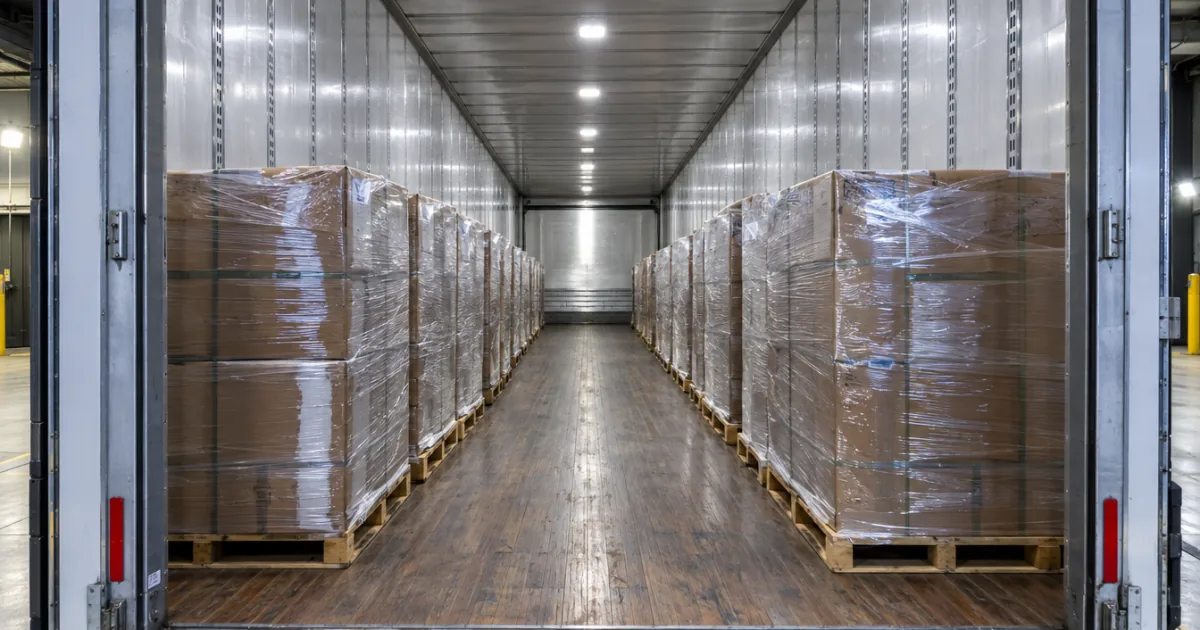
How many pallets fit in a 53 foot trailer comes down to how they are loaded: 26 standard 48 × 40 pallets loaded straight, or 30 turned, in a dry van with 630 inches of inside length. Loads of 55 inches or less that can be double-stacked make it 60. The calculator below works out any trailer, box truck or container and draws the floor plan.
- Straight, turned or the best mix
- 53 ft vans, reefers, box trucks, containers
- Load diagram, share and CSV
Pallets per trailer calculator
Pick the equipment and the pallet. Floor count, stacking, linear feet and a load diagram, as you type.
26 or 30 is a forklift decision, not a trailer fact
Ask how many pallets fit on a 53 foot trailer and both 26 and 30 are right answers for the same trailer. Set 48 × 40 pallets in straight, the 48-inch side running down the trailer, and they go two across in 13 rows: 26. Turn them so the 40-inch side runs down the trailer and the 48-inch sides go across, and 15 rows fit: 30. The trailer didn't change. The person on the forklift did.
Turning has a price, and it's width. Two turned pallets side by side span 96 inches. The 53 ft dry van behind these figures, a Hyundai Translead model published at 98.5 inches lining to lining, leaves 2.5 inches. A trailer narrower than 96 inches anywhere along the floor can't take 30 this way, so how many standard pallets can fit on a 53 foot trailer of yours is a question for a tape measure.
Containers have their own version of this. You'll read that a 20 ft container takes 10 standard pallets. On the published inside floor of one carrier's 20 ft box, the most that fit is 9, and the arithmetic is below.
Straight, turned and pinwheel loading
ATS, a carrier, publishes counts for three ways to load 48 × 40 pallets in a 53 ft van: 26 straight, 30 turned and 28 pinwheel. Pinwheel mixes the two orientations: a straight pallet beside a turned one spans 88 inches (40 + 48) where two turned need 96.
The calculator's "Load them" setting offers All straight, All turned, or Most pallets, which searches straight, turned and mixed floor plans, keeps the highest count and lists the all-straight and all-turned counts beside it when they differ. In the top-view diagram, nose on the left, straight pallets are blue and turned ones orange.
| Pallet | Straight | Turned | Notes |
|---|---|---|---|
| 48 × 40 in (standard) | 26 | 30 | 30 uses 50.0 ft of floor |
| 48 × 48 in | 26 either way | Square | |
| 42 × 42 in | 30 either way | Exactly 630 in; 28 with any clearance | |
| 48 × 45 in | 26 | 28 | 28 is exactly 630 in (14 × 45); 26 with an inch of clearance |
| 36 × 36 in | 34 either way | 17 rows of two | |
| EUR 1200 × 800 mm | 39 | 40 | 39 is three across; 40 leaves 0.1 in, so 39 with an inch of clearance |
| 1200 × 1000 mm | 26 | 32 | 32 leaves under 0.1 in; 30 with an inch of clearance |
Linear feet
Linear feet is the length of floor the load takes; the calculator shows it beside the length left over. Thirty turned pallets use 600 inches, 50.0 feet, leaving 30 inches at the doors; twenty-six straight use 624 inches, 52.0 feet. If a load won't fill the trailer, that's the figure for how much of it you need.
Reefers, 48 ft trailers and 26 ft box trucks
How many pallets fit in a truck other than a 53 ft dry van comes down to the same two inside measurements: length sets the rows, and width decides whether the pallets can turn.
Reefers and composite vans
Hyundai Translead publishes its ThermoTech reefer at 626 × 97.4 × 105.5 inches inside, smaller than the dry van every way, and it still takes 26 standard pallets straight or 30 turned, with 1.4 inches to spare across: thin enough to measure your own unit before promising 30. EUR pallets drop to 39. The same builder's composite dry van is 101.5 inches wide, yet 48 × 40 pallets still come to 26 or 30, because length is what stops them.
48 ft trailers
This page has no verified inside length for a 48 ft trailer, so measure yours. If it is at least 96 inches wide, standard pallets turned come to the inside length in inches ÷ 40, rounded down, times two; straight, the length ÷ 48, rounded down, times two. Enter the measured length and width as Custom and the calculator checks mixed plans too.
How many pallets fit in a 26 ft box truck?
Fourteen standard pallets turned, or 12 straight, on Penske's published maximums for its 26 ft truck: 25 ft 11 in by 8 ft 1 in, or 311 × 97 inches. Fourteen leaves 1 inch across, so 2 inches of clearance brings it to 13, and wheel wells and the door frame often cost a position as well. Penske lists up to 10,000 lb of load capacity, which means 14 pallets averaging about 714 lb or less.
How many pallets fit in a 20 ft or 40 ft container?
Nine standard pallets in a 20 ft and 20 in a 40 ft, on Hapag-Lloyd's published inside dimensions, which it describes as examples from its fleet.
| Container, inside (mm) | 48 × 40 in | EUR 1200 × 800 mm | 1200 × 1000 mm |
|---|---|---|---|
| 20 ft standard, 5,900 × 2,352 | 9 (8 all straight) | 11 mixed (8 all straight) | 9 |
| 40 ft standard, 12,032 × 2,352 | 20 | 25 (23 with 5 cm clearance) | 22 |
| 40 ft high cube, 12,032 × 2,350 | 20 | 25 (23 with 5 cm clearance) | 22 |
Why a 20 ft container takes 9, not 10
A standard pallet is 1,219 × 1,016 mm, and Hapag-Lloyd's 20 ft standard container is 5,900 × 2,352 mm inside. The plan the calculator draws loads four rows of two straight, each row 1,219 mm deep and 2,032 mm across, then turns one more pallet across the nose, 1,016 mm deep. That is 4 × 1,219 + 1,016 = 5,893 mm of a 5,900 mm floor. A fifth straight row would need 6,096 mm, and a turned pallet only fits one across, so the exact search finds no layout with a tenth. A straight column beside a turned column also stops at 9. All straight, it's 8. With 2 cm of clearance it is still 9.
EUR pallets show why the mix matters. All straight, a 20 ft takes 8; seven turned (5,600 mm) beside four straight (4,800 mm) span 2,000 mm across and make 11. In a 40 ft the same idea gives 25, each column using 12,000 of the 12,032 mm. Allow 5 cm of clearance and it's 23, which matches the 23 or 24 forwarders quote.
The 40 ft high cube shares the standard floor, so its floor counts match; the difference is 2,700 mm of inside height against 2,395. Pick a container and the calculator enters its published payload as the payload limit (28,130 kg for the 20 ft, 28,750 kg for the 40 ft, 28,600 kg for the high cube). For cartons, the CBM calculator works out container fill by volume.
Why counts quoted elsewhere differ
Every count here is wall to wall, with no allowance. Real loads lose some space to door frames, corrugated container walls, overhanging pallets and the gaps a forklift leaves, and published counts assume different inside dimensions, pallets and allowances. The calculator warns when a plan fits with almost nothing to spare, such as 42 × 42 pallets filling 630 inches exactly. To build in an allowance, enter it under Clearance to leave; it comes off the length once and the width once.
Double-stacking: 60 pallets if the freight allows it
Height only adds pallets when the freight can carry a second tier, which is the shipper's call, so the calculator ignores it until you tick "The freight can be double-stacked". Then it divides the inside height by the loaded pallet height and rounds down. The 53 ft dry van is 110 inches high inside: pallets of 55 inches or less go two high, 60 in all. At 56 inches it's back to 30.
Containers are lower. Two tiers in a standard box, 2,395 mm inside, need each loaded pallet at about 1,197 mm (47 in) or less, and a high cube raises that to about 1,350 mm (53 in).
Weight runs out before floor space
On the Interstate System the federal limit (23 CFR 658.17, as the Federal Highway Administration summarizes it) is 80,000 lb gross vehicle weight unless the bridge formula sets it lower or a higher weight is grandfathered, with 20,000 lb on a single axle and 34,000 lb on a tandem. The tractor and trailer count toward the 80,000, so payload is a figure for your own equipment, not a standard. Thirty pallets at 1,500 lb put 45,000 lb on the floor; whether that is legal depends on the tractor, the trailer and the axles.
Fill in Weight each and a payload limit, and an overweight load gets a warning with the most pallets the payload allows: payload ÷ one pallet's weight, rounded down. Counting pallets per truckload by floor space alone is how a full truckload turns into an overweight one.
Copy results, Share link, Save in this browser, Download CSV and Print sit under the result. The pallet count you load is the handling-unit count the carrier signs for, and how to fill out a bill of lading explains how it differs from pieces. Build each pallet with the pallet calculator and check its class with the freight class calculator.
Pallets per trailer questions
How many skids will fit on a 53-foot trailer?
Skids are counted the same way as pallets: a 53-foot dry van takes 26 standard 48 × 40 skids loaded straight or 30 loaded turned, on a published inside floor of 630 × 98.5 inches. Turned loading needs at least 96 inches of clear width. Square 48 × 48 skids come to 26 either way, and 42 × 42 skids reach 30 only if the trailer gives you the full 630 inches; with any clearance it is 28.
How many pallets fit in a 40 ft trailer?
It depends on that trailer's inside length, which varies by model, so measure it. For standard 48 × 40 pallets in a trailer at least 96 inches wide inside, turned loading takes the inside length in inches divided by 40, rounded down and doubled; straight loading takes the length divided by 48, rounded down and doubled. A 40 ft container is a different thing: Hapag-Lloyd's takes 20 standard pallets.
How many pallets can fit in a 53 ft container?
There is no verified inside size for a 53 ft container behind this page, so it gives no count for one. Measure the inside length and width, or get them from the owner, and enter them as Custom. If the floor is at least 96 inches wide, standard 48 × 40 pallets follow the trailer rule: the inside length in inches divided by 40, rounded down and doubled, loaded turned.
How many pallets fit in a 20-foot container?
Nine standard 48 × 40 pallets on Hapag-Lloyd's published inside floor of 5,900 × 2,352 mm, laid as four rows of two straight with one more turned across the nose. All straight, it is 8. The figure of 10 that is widely quoted does not fit those dimensions. EUR pallets reach 11 with the same kind of mixed layout, and 1200 × 1000 mm pallets reach 9.
How many pallets fit in a 40-foot container?
Twenty standard 48 × 40 pallets on Hapag-Lloyd's published 12,032 × 2,352 mm floor, and 22 of the 1200 × 1000 mm size. EUR pallets reach 25 wall to wall, using 12,000 of the 12,032 mm, and 23 once 5 cm of clearance is allowed, which matches the 23 or 24 that forwarders quote. A 40 ft high cube has the same floor, so the counts are the same.
Can I double-stack pallets in a container?
Yes, if the freight can bear a second tier and both tiers fit under the inside height. In a standard container 2,395 mm high inside, each loaded pallet must be about 1,197 mm (47 in) or less for two tiers. A high cube's 2,700 mm allows about 1,350 mm (53 in). Whether the product can be stacked is the shipper's call, which is why the calculator only stacks when you tick the double-stack box.
What is a high cube container?
A high cube is a container with more inside height than a standard one on the same floor. Hapag-Lloyd's 40 ft high cube is 12,032 × 2,350 × 2,700 mm inside, against 2,395 mm of height in its standard 40 ft, with a door 2,597 mm high, and it holds 76.3 m³ to the standard's 67.7. Floor counts are the same; the gain is height.
What limits pallet capacity before trailer space is full?
Weight is the first limit to check. The federal limit on the Interstate System is 80,000 lb gross vehicle weight unless the bridge formula sets it lower, with 20,000 lb on a single axle and 34,000 lb on a tandem, and the tractor and trailer use part of that. After weight come height, which limits stacking, and the trailer's width, which decides whether pallets can be turned.
How many pallets fit in a 26-foot box truck?
Up to 14 standard 48 × 40 pallets turned, or 12 straight, using Penske's published maximums for its 26 ft truck of 25 ft 11 in by 8 ft 1 in, which is 311 × 97 inches. The 14 leaves 1 inch across, and allowing 2 inches of clearance drops it to 13. Wheel wells and the door frame often cost a position too, and the truck's load capacity, up to 10,000 lb, may run out first.
Can you fit 30 pallets on a 53-foot trailer?
Yes. Thirty standard 48 × 40 pallets fit when they are loaded turned: 15 rows of two, with the 48-inch sides across. That needs at least 96 inches of clear width and uses 50 feet of a 630-inch floor. Straight, it is 26. Going past 30 takes double-stacking, which in a van 110 inches high inside works when each loaded pallet is 55 inches or less.